
Whether you are a beginner or more experienced with electric fencing, here are some of our favorite tips from Gallagher Territory Managers and Support Techs that will help you improve your fencing skills.
Did you know that there are right-handed and left-handed fence staples? Put the staple in your hand with the points aiming away from your body. If the slash/flat area is visible on the right-hand point, then it’s a right-handed staple and should be rotated slightly to the right (clockwise) before driving. If the slash is not visible, it is a left-handed staple and should be rotated to the left. Correct rotation ensures the staple is secure and discourages wood splitting.
Alex Wright - Alex Wright, Territory Manager for New England States
When it comes to grounding your electric fence, as a rule of thumb, use a minimum of 3 ground rods or the Energizer stored Joules rating divided by 5.
Wes Chism - Wes Chism, Territory Manager for Missouri & Southern Illinois
Planning before you begin is key. Sketch out the area you are fencing. Think about water sources in relevance to the fence as well as gates wide enough to gather or move livestock with ease. Check out Gallagher’s Fence Selection tool to help you with this process.
Lee Ellsworth - Lee Ellsworth, Territory Manager for Texas/Arizona/New Mexico
Consider installing a temporary fence for a period of time to see if it works for your needs before installing a permanent one.
Wes Chism - Wes Chism, Territory Manager for Missouri & Southern Illinois
Setting your electric fence far enough from a creek or bank will allow you to pass a brush hog alongside of it to help keep weeds/brush off the hot wire. The same is true for a garden fence. If you allow enough room from your outside rows, you can use a tiller without touching the wire.
Alex Wright - Alex Wright, Territory Manager for New England States
Did you know that high tensile wire comes off a pay-out spinner counter clockwise? This keeps the drag on the payout spinner from tightening up as wire is paid out.
Randy Bailey - Randy Bailey, Territory Manager for California, Nevada, Oregon & SW ID
When installing electric fence, use joint clamps to connect leadout wires and underground cable. Do not wrap the wire onto the fence, as it can arc and will make your fence’s voltage drop simply due to resistance.
Scott Rooney - Scott Rooney, Technical Support Manager, North America
When underwiring a gate on a hot/ground fence – mark the ground or hot insulated underground wire with electrical tape so you don’t connect the underground wire to the wrong fence resulting in a dead fence when you are finished.
Randy Bailey - Randy Bailey, Territory Manager for California, Nevada, Oregon & SW ID
If you take care of your tools, they will return the favor. Hand tools such as pliers, crimping tools, wire cutters and wire strippers should never be laid on the ground. Keeping tools in your hand, tool belt or bucket will not only keep them clean so you can get optimum use out of them, but it will also prevent them from getting lost.
Randy Bailey - Randy Bailey, Territory Manager for California, Nevada, Oregon & SW ID
If you are going to use screw-in ring insulators, make sure you invest in a drill bit. Just put it in a cordless drill, slot in a ring insulator and let the drill screw the insulator into the fence post.
Wes Chism - Wes Chism, Territory Manager for Missouri & Southern Illinois
Gallagher Fence Tester. Own a fence tester and know what your fence typically reads. If your fence shows 5.0kV and you test it one day and have 3.0kV, you know there is an issue. If your fence shows 5.0kV and your neighbor says their fence reads 7.0kV, that doesn’t mean you have a problem with your fence. Both of your fences are effective and there is nothing wrong with a fence reading 5.0kV. In fact, you just need to maintain a minimum level of 3.0kV.
Scott Rooney - Scott Rooney, Technical Support Manager, North America
To break off excess high tensile wire, place a 90° bend in the wire about 6″ beyond the knot. Grasp the wire just beyond the bend and crank it parallel to the fence line (back toward the post or splice). The wire will snap right off. The faster you work, the easier the wire is to break. High tensile wire gets hot when worked slowly. When hot, the wire becomes more difficult to work and break off.
Randy Bailey - Randy Bailey, Territory Manager for California, Nevada, Oregon & SW ID
In line Wire Tighteners are handy for tightening a sagging existing fence. They fit over the fence wire and increases the effectiveness of the strain by pulling from both directions without needing to cut any wire.
Alex Wright - Alex Wright, Territory Manager for New England States
When rewinding long lengths of wire, the extra cost of the geared reel over a standard reel is a worthwhile, time-saving investment. Gallagher Geared Reels have a 3:1 ratio, which means for each turn of the handle, the bobbin spins 3 times, enabling you to collect your wire 3 times faster.
Alex Wright - Alex Wright, Territory Manager for New England States
Check for tax credits. Cost-share opportunities through government programs may be an option. Consult with your Natural Resources and Conservation Service (NRCS) agent before beginning any major fence project. https://www.nrcs.usda.gov/
Wes Chism - Wes Chism, Territory Manager for Missouri & Southern Illinois
Get the most out of your Electric Fence!
Dedicating 45 years to the fencing industry isn't a career – it's a passion. For Merle Mohr, the decades spent working on behalf of Gallagher and focusing on its quality and dependable products have taught him a thing or two about electric fencing. Merle Mohr provides 5 key factors to maximizing your electric fence system below:1. Select the right energizer
Choosing the appropriate energizer for your individual property and electric fence needs is the first step to a successful electric fence system. "Talk to a Gallagher representative about your objectives to ensure you're getting the proper amount of joules to maximize your cost and energy efficiency," says Mohr.View Gallaghers Energizer Range
2. Be flexible with the wire
Give your wire a little flexibility and it won't give you a worry, says Mohr. "This isn't barbed wire, the line doesn't need to be super taut to be effective," he explains. "Adding some flex in the wire allows for curious wildlife on your property as well as unpredictable changes in weather. You can always go back and tighten the line during the summer dry months if needed."View Gallaghers Hi Tensile Wire Range
3. Use good insulators
While constructing a new fence system, some consumers staple the high tensile wire directly to the fence – which works great if the post is dry and will remain dry, says Mohr."Unfortunately, most climates offer varying degrees of moisture – whether rain or snow, or often times – both," says Mohr. "Select and use a good, quality insulator and you won't be shorting out during weather storms or compromising your overall fence system."
View Gallaghers Insulator Range
4. Monitor the spacing of the posts
Mohr's rule of thumb is to plan for approximately 50-60 feet apart with a stay in between each post."Anything less is going to be too close, won't give and wildlife is going to run right through the line," says Mohr. "Not only is this a more efficient fence strategy, it's also a more cost-effective strategy as you're using – and purchasing – fewer posts."
View Gallaghers Posts Range
5. Develop a proper grounding system
Most people don't put too much thought in to their grounding system, Mohr says. "But they should. Approximately 80% of all power fence problems stem from inadequate grounding. The ground posts help maximize the overall electrical efficiency of your entire fence system," he explains.Mohr recommends at least three grounding posts made of galvanized steel.
View Gallaghers Grounding Range
Electric horse fencing is economical, reducing cost by as much as 50% less than traditional non-electrified fences. An electric horse fence also takes less than half the time to build compared to traditional fence systems, saving you time and money.
In addition to the cost savings, electric fencing for horses act as a psychological barrier and many times are safer than a traditional non-electrified fence. Horses remember the short, sharp, but safe shock and develop respect for the fence. This also has the advantage of increasing the longevity of your fencing system as horses will be less likely to make contact with your fence causing wear and tear.
Getting started
There are two types of electric fencing for horses; permanent and temporary. Either of these options may be powered with four energizer options: 110v plug-in, battery, battery/solar or solar energizers.
A permanent electric horse fence system is suited for long-term horse control and is the most effective way to control horses while maximizing pasture efficiency. It is important to make sure your electric fence system is constructed properly. The effectiveness of your electric horse fence depends on the correct combination of these four factors for your particular situation:
- The energizer you select
- A ground system
- Well insulated fence system
- An adequate lead-out (connection between the energizer and the fence)
Temporary electric horse fencing provides flexibility in pasture management and is ideal for short-term horse control or rotational horse grazing.
Easily transported, constructed and maintained, temporary horse fencing is an effective portable fencing solution, which can be powered by 110v plug-in, battery, solar/battery or a solar energizer.
The main uses of temporary electric fencing are:
- Grazing pasture and crops
- Short term horse control
- Intensive grazing
- Impromptu, portable fencing – corrals when travelling / protection of hay bales, silage and restriction of water ways
Portable electric fencing has many benefits:
- Fast and easy installation
- Re-usable / portable
- Cost effective
- Convenient to transport / carry
Electric Fencing Materials Designed for Horses
Gallagher produces some of the most effective fencing products for horses, such Equine Fence. Equine Fence is the safe, effective solution for your permanent horse control. Not only does it have a galvanized medium tensile wire core, coated with a high stress crack resistant polyethylene pipe to ensure long life – the white wire increases visibility.
Gallagher have also developed the Turbo Equine Braid and Turbo range of horse tape products, offering both safety performance and longevity through the mixed metal strand system designed to conduct further than standard braided product and poly tape.
Gallagher offers a range of monitoring devices which allow you to maintain your electric fence performance and efficiency.
Not only does electric fencing keep domestic animals or livestock contained, it has various other important uses, including keeping unwanted animals out; separating different groups of animals; allowing rationing of crops and pasture; and ensuring animal and human safety by fencing animals off from eroding areas, trees, rivers and roads.
These are all important applications which depend on consistent, reliable electric fence performance. Power fluctuations or interruptions can occur due to animals breaking through or other items making contact with the fence wire, grounding the current.
Fault Finder in Pocket Depending on which products you choose, Gallagher North America can enable you to monitor your fence on and off farm. These systems also detect and regulate current fluctuations so your fence’s performance stays within the required levels.
Fence tools and testers are another useful accessory to have on hand when building, maintaining or checking an electric fence. Gallagher has two fence testers, both available from your local Gallagher Dealer. The Fault Finder is a all-in one device, each featuring a volt meter, current meter and fault finder. The Volt Meter measures volts only.
CHECKING YOUR ENERGIZER VIDEO
PLEASE NOTE: To measure voltage accurately a tester that is specifically designed for electric fencing should be used.
CHECKING YOUR GROUNDING SYSTEM (A.K.A. EARTHING)
See how it is done in this short video clip.
FINDING FAULTS ON YOUR FENCE
Watch this video for help identifying and correcting faults on your fence line.
Electric fences are designed to prevent animals from accessing or exiting a particular area and are regulated to ensure they operate safely. Existing laws prohibit the sale, installation, or use of an electrified fence connected to a source of electrical current unless the current is limited and regulated by an energizer controller that meets specified standards.
Despite high voltages of over 5000 volts, electric fences are much safer than one might assume. Hundreds of thousands of people worldwide encounter electric fences every day, and electric fences account for less than one serious injury per year worldwide. This is compared to the numerous injuries and deaths that result from human exposure to machinery, animals, and weapons.
The safety of electric fences in urban areas is achieved through two main factors: the voltage and the current. While the voltage is high, the current or amplification is very low, with figures ranging from 15 to 500 milliamps. This is a small fraction of the amperage used to power machinery and utensils, such as a cooker, which may draw up to 30 amps.
Electric fence energizers put out high voltage, around 7,000-8,000 volts, which gets the animal’s attention. However, they reduce the deadly amps to a very low amperage, usually around 120 milliamps. Modern fence energizers use low-impedance circuitry, which charges a capacitor by a solid-state circuit and releases the charge with a thyristor. This results in a controlled voltage delivery and a shorter shock pulse, lasting only a few milliseconds.
The pulsating current in electric fences is also safer than continuous supply because it allows animals or people to remove themselves from the source of electricity. The muscle contraction caused by the shock is transitory, and the affected animal or person can retreat from the fence. In contrast, continuous supply results in a grabbing effect that can be dangerous and makes it impossible to release the source of the current.
In conclusion, electric fences in urban areas are a safe and regulated solution for controlling access to certain areas. While they may seem dangerous due to their high voltages, they operate with very low currents, and their pulsating current allows targets to remove themselves from the source of energy.
Farms
Electric fences are effective for animal containment and exclusion in urban areas. However, there are concerns about the safety of electric fences for humans. This white paper aims to provide evidence-based information on the safety of electric fences for animal containment and exclusion in urban areas with proper installation.
Safety Features of Electric Fences
Electric fences installed in urban areas if installed properly can be safety used with minimum risk of harm to humans. These features include warning signs, insulators, and ground rods. Warning signs are essential to ensure that humans know the electric fence's presence, avoiding accidental contact. Insulators help prevent electrical arcing and ensure that the current flows through the wire instead of through the fence posts.
According to a study by the University of Minnesota Extension, electric fences installed with proper safety features, such as warning signs and insulators, significantly reduce the risk of injury or harm to humans (Schulte et al., 2012). The study also found that electric fences designed for animal containment purposes in urban or rural areas are low impedance voltage, which is not life-threatening to humans. While touching an electric fence does cause a harsh shock, the low number of amps used in the fence prevents this from being serious or deadly. As electric fences use high voltage but low amplitudes, injuries caused by them are very rare.
Proper Installation of Electric Fences
Proper installation of electric fences is crucial for the safety of humans. The installation should be installed according to manufacturer instructions, warnings, and placards or by a professional with experience in installing electric fences. The electric fence should also be installed according to local regulations and standards.
A study by the University of California Agriculture and Natural Resources found that proper installation of electric fences significantly reduces the risk of injury or harm to humans (Linn, 2005). The study also recommended regular inspections of electric fences to ensure that all components are in good condition and that there are no loose or damaged wires.
Maintenance of Electric Fences
Regular maintenance is essential for the safety of electric fences. Neglecting to maintain an electric fence can result in irregular operation and ineffective containment of exclusion. Regular inspections should be performed to ensure that all components are in good condition. Any damaged or broken parts should be replaced immediately. The fence line should be kept clear of any vegetation or debris that may interfere with the operation of the fence. If a solar energizer is utilized, the battery, charging system (if applicable), and energizer should be checked regularly with proper electric fence testers to ensure that they are functioning correctly. In the instance of a mains energizer (110v), the energizer cannot be located outside in the weather and needs to be connected to a GFCI-protected outlet.
References:
Burrows, G. E., et al. (2004). Electric Fencing for Serious Graziers. University of Nebraska-Lincoln Extension. Retrieved from https://digitalcommons.unl.edu/cgi/viewcontent.cgi?article=1286&context=extensionhist
Linn, J. G. (2005). Electric Fencing Basics. University of California Agriculture and Natural Resources. Retrieved from https://anrcatalog.ucanr.edu/pdf/7249.pdf
Schulte, B. A., et al. (2012). Fencing Systems for Livestock Production. University of Minnesota Extension.
The earthing system of your electric fence must be as conductive as possible for the fence to give the animal an effective shock. A simple guide is one earth stake for every five joules of stored energy with a minimum of three earth stakes.
Additionally, you will need to set up your electric fence according to how ‘green’ the area is all year round.
All Live Wire System - best suited for wetter regions
For use in greener regions with good earth conductivity. All fence wires connect to the red terminal on the Energizer and a shock is delivered to an animal when it’s touching the ground and the fence at the same time.
Testing on All Live Wire Ground System
This should be done once a short section of fence has been built. You should test your system at least once a year at the height of any dry period to ensure the grounding capacity is sufficient for the joule rating of the energizer.
Short the fence out at least 330’ away from the ground system by using several ground rods between the wires and the ground. Reduce the fence voltage at this point to 2000V (2kV) or less.
Using a Volt Meter, measure the voltage between the wire connecting through the ground rods to the Energizer ground terminal and an independent ground rod. This rod should be a galvanized metal rod, minimum 8” long. Place the rod 3’away from the ground rods or as far away as your Volt Meter cable will reach.
There should be no reading on the Volt Meter; however, up to 200V (0.2kV) is acceptable. If the voltage is higher than this, switch off the Energizer, drive in more ground rods at the recommended spacings and connect them to the existing ground system until the voltage is down to the acceptable level.
Earth Return Wire System – Best suited for drier regions
For use where the ground struggles to conduct enough power (for year-round dry, frozen or snow conditions). The live and earth wires on the fence create the shock when the animal touches them both at the same time.
Testing a Ground Return Wire System
Install a 2m earth stake as close a possible to the end of the fence. Install a 500ohm load tester between a hot wire and ground wire. Choose the location for the ground rod in a damp area if possible. If you cannot find a damp area, the ground test may be unreliable.
Using a Voltmeter, measure the voltage between the hot wire and the ground wire across the load tester you just installed. Next measure the voltage between the hot wire and the independent ground rod, leaving the load tester in place.
If the second voltage reading exceeds the first by more than 1000V (1kV) check the ground return wire for loose connections. Finally, connect the independent ground rod to the ground return wire as a permanent connection. Extra ground rods can be added at various places around the fencing system and connected to the ground return wire to improve ground performance.
If the first voltage reading is less than 3kV, your fence system is at risk of poor animal control. Assuming that your ground wire return checked out satisfactorily, check that the fence hot wire has good connections. If connections are good, it is possible that your energizer is too small for your fence system.
Eight generations and 215 years of experience in the cattle business have taught the Lowe family of Smiths Grove, Kentucky the importance of quality when it comes to raising cattle. Kenneth Lowe explains his family's roots in the cattle business began with a feeding and finishing operation in the mid-1800s. The family business eventually transitioned their focus to a commercial cow herd in the early 1960s. Upon graduating from college in 1976, Lowe decided to stake his own claim and started Oak Hollow Angus after purchasing the farm next door to his mother and father's operation.
Angus was Lowe's breed of choice from the very beginning. "I've never found any other breed that allows me to produce pounds of beef as efficiently as my Angus cow," says Lowe.
When it comes to producing quality cattle, Lowe says, it is a two-fold thing. For Lowe, his breeding program focus is all about the females. Currently his operation breeds about 350 to 400 females a year, calving out approximately 250 to 300 on the farm and selling the rest as bred females.
"My whole program is about building a better factory," says Lowe, "A cow that can breed at 15 months, calve at 24, do it unassisted, breed back, and do it again every 12 months until she is 12 or 15 years old."
Lowe chose to focus Oak Hollow Angus's breeding program strongly on maternal and production traits such as fertility, calving ease, milk production, and growth. He believes these traits are the most important in making a commercial cow-calf operation profitable.
When it comes to producing quality cattle, Lowe says, it is a two-fold thing. "One, we want to produce an end product of the highest quality, but the other part of that is also to produce it at the lowest cost," Lowe says. "So I guess when it comes to quality (on a breeding operation), it's talking about selling breeding stock that will help make commercial customers maximize their bottom line."
Like most Angus producers, detailed records are an important part in maintaining breed quality on Lowe's operation. According to American Angus Association CEO, Bryce Schumann, quality in the Angus breed is measured, tracked and improved upon over time through data collection on the ranch level.
"Records submitted by breeders, like birth weight, weaning weights, calving records, feed intake, are used to build the American Angus Association's vast suite of EPDs (expected progeny differences) and $Values, along with pedigree and genomic information," says Schumann.
Thanks to producers' record-keeping efforts and submission of DNA samples for high-density tests to produce genomic-enhanced EPDs, the American Angus Association boasts the industry's most advanced and accurate genetic prediction tool available to breeders.
This focus on tracking and improving upon quality transfers through into the management tools Oak Hollow Angus uses to gather these records. A key component of this record-keeping system is weighing cattle.
Lowe uses an electronic weighing scale placed under his chute to record weights on cows and calves at birth and weaning, and as yearlings. In addition, measurements such as weaning and yearling heights, along with ultrasound scans of ribeye area, backfat thickness and intramuscular fat are also taken on calves during processing.
"Having electronic scales just allows us to get that reading a little quicker," says Lowe. "We're recording information on height, condition score, and ID numbers all at the same time; it's just a lot smoother."
Along with weighing systems, Lowe believes high quality, reliable fencing equipment is a must for running an efficient cattle breeding operation.
"I've been using Gallagher chargers since 1980," says Lowe. "At that time there were no other choices that were even close that I know of. If you want to use a fence charger, to me Gallagher is the one you should compare to, it's the top of the industry."
Lowe anecdotally says when people come to buy bulls, sometimes they spend as much time talking about fencing as they do about cattle.
Fencing is a system of components, says Lowe, and if one component fails, the whole system fails. By using Gallagher products, he has an economical fence which holds up and performs like it is supposed to so he doesn't have problems.
"In breeding cattle and putting up fence and how I manage my employees, let's eliminate problems," says Lowe. "Problems cost me money."
Last year, Oak Hollow Angus turned out 18 different herd sires in their breeding herd. Doing this involved a lot of natural service and keeping different breeding groups separate. There is no way to do this except good fencing, Lowe says.
According to Lowe, running electric fencing on the farm is a lot like having electricity in every room of the house – it needs to be the same way.
"I want electric fencing all over the farm so any time I need to run a fence for any reason all I have to do is tie it right onto my existing system," says Lowe. "It's all about managing where these cattle graze and how you control them."
Lowe says he could not imagine taking care of the amount of cattle he does without quality electric fencing.
With what it takes to make agriculture work today, Lowe says, you need all the help you can get. Having quality management tools to work with helps to make his day a little easier, allowing him to focus more on the important things in life like his family and producing quality Angus cattle.
There are several different types of portable electric fence wires, tapes and braids - frequently called “conductors”. Knowing which one to choose can be a bit tricky - especially for those new to electric fencing.
Here we take you through the different types of conductors available to help you make the right choice for your farm:
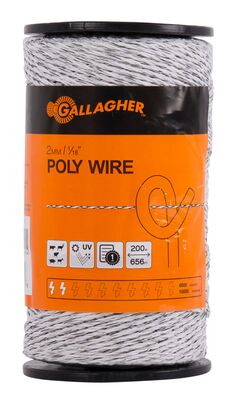
Poly Wire
The most common portable/temporary fence “conductor” is Poly Wire. Poly Wire is made of plastic strands and embedded thin metal wires used to carry electrical current from a Fence Energizer. The individual strands of plastic and wire are typically twisted tightly together to form a single wire.
Poly Wire lacks the strength of steel wire fencing but it won't rust and is more visible to animals. Wires less than 3mm in diameter are popular for cattle, sheep, goats and pigs, while larger 5mm diameter versions are suitable for horses due to improved visibility.
As it’s available on a reel, it provides a convenient option for temporary fencing solutions, such as strip grazing, and also offers a cost-effective option for subdividing pastures.
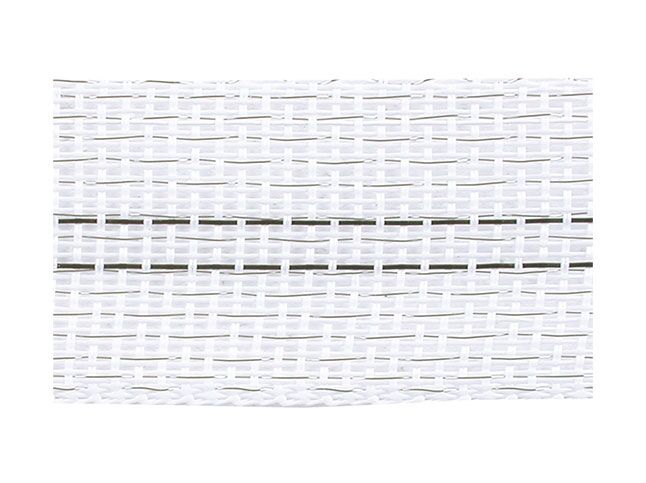
Poly Tape
Poly Tape threads individual strands of plastic and wire together creating what appears to be a highly visible ribbon. Tape is strong, can withstand all weather conditions, and won’t rust. White tape is more visible against green vegetation or brown landscape, whereas brown or green tape is more visible against a snow background.
Electric poly tape is available in different widths with each width being better suited for different applications. Because of its enhanced visibility and superior strength, the thicker tape is recommended for perimeter fences, but it’s not the best solution in areas that experience strong winds – in these situations, Poly Braid would make a better choice for perimeter fencing.
If exposed to a windy area a thinner Tape provides is better suited as their thinner width provides less resistance to winds, and thus are less inclined to suffer wind damage.
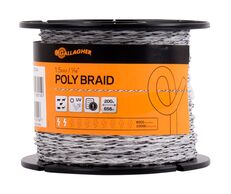
Poly Braid
Poly Braid is a superior construction than Poly Wire, and is less likely to be damaged by the wind and ice than Poly Tape.
Poly Braid consists of individual strands of plastic and wire that are braided together to form a tight weave making it more durable, and less prone to tangles and overstretching. Poly Braid comes in various diameters (thickness).
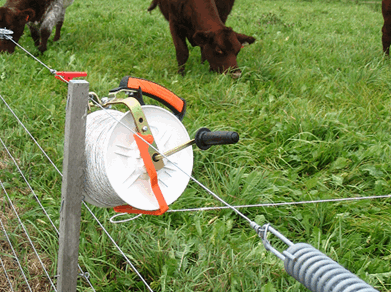
High Tensile Wire Fencing
High Tensile Wire is suitable for permanent fences over a large area. However, as wire fences don’t give like a Poly Tape or Poly Braid fence, high tensile wire fencing isn’t suitable for fast-moving animals, such as horses, who could succumb to serious injury if they run into the wire at speed.
High-tensile wire is available in two options: galvanized steel and aluminum. Both are strong, hard-wearing, and low maintenance, and are a good choice for constructing perimeter fences to contain slow animals. Galvanized steel offers an economic solution that will effectively carry an electric charge long distances. Aluminum offers superior conducting capabilities – four times as much as galvanized steel however, it tends to be more expensive than steel wire.
Turbo wire
Turbo products come in the same wire, tape and braided construction previously described for Poly - with one major difference. Turbo products have 9 strands of conductive metals including copper which make them up to 48x’s more conductive than Poly products which only have 6 strands of stainless steel. This means with Turbo, your voltage will stay strong and carry a “shock” further down your fence line than Poly products. Long temporary fences (over 200m) should always be constructed from Turbo products to ensure maximum livestock control.
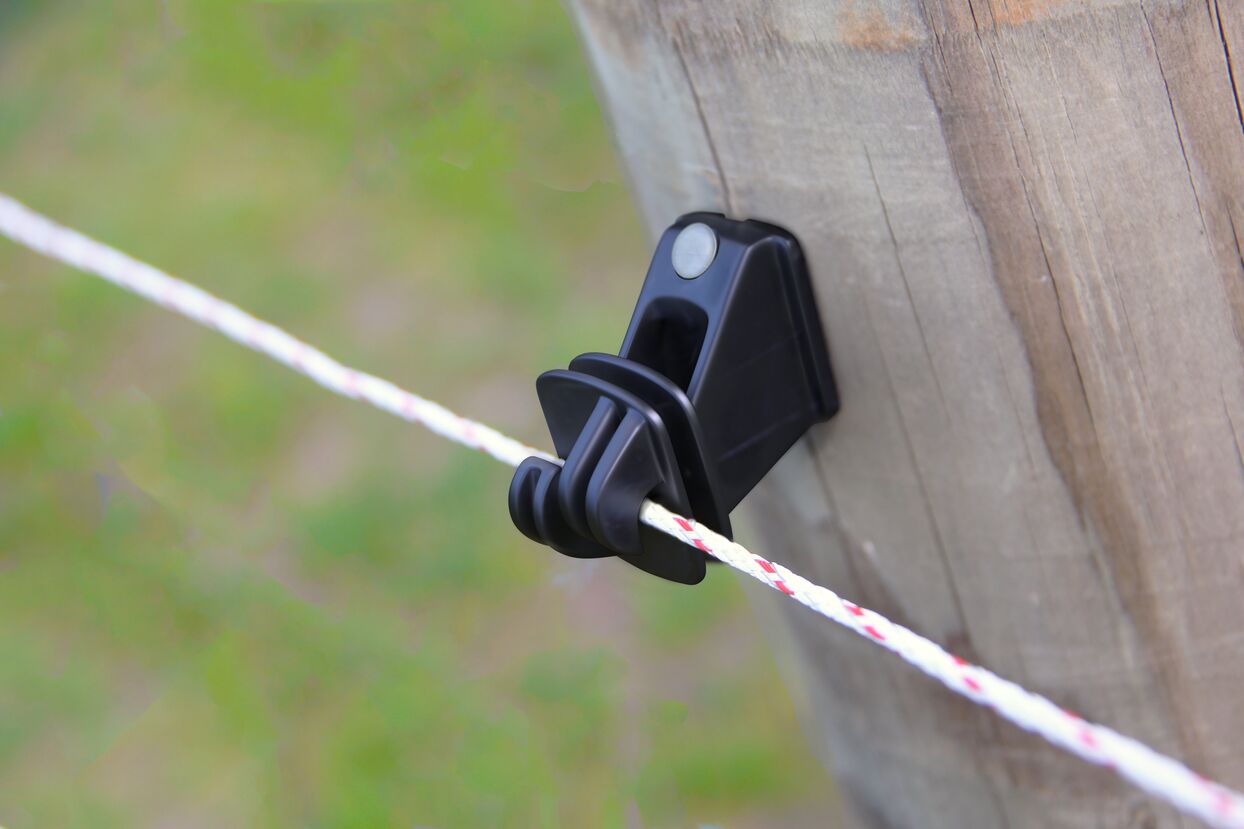
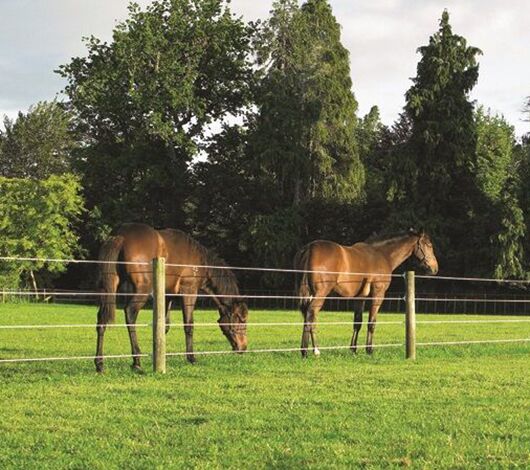
Equine Fencing
If you own horses Equine Fence Wire is the safest, most effective electric fence for your horse. This long life, high tension fence uses specially designed wire coating to reduce risk of injury.
Turbo Braid can be used as a low tension semi-permanent fence alternative to Equine Fence Wire. Braid is designed not to tangle or overstretch and is easy to install.
A semi-permanent Tape fence is highly visible, simple to construct and will last years, making this type of fence an economical and popular choice for horse owners.
Did you know?
All our cables – like the Heavy Duty Leadout Cable, the Equine Fence Wire and the Double Insulated Soft Cable - are made in our factory in New Zealand and come with a 10 year warranty.
The Earthing System
The earthing system refers to the galvanized metal stakes that are placed in the earth near the energizer. The metal stakes in the ground are part of the circuit that is completed when the animal touches the wire. The completion of the circuit is what allows the animal to get a shock. The energizers earthing system must be as conductive as possible for the fence to give the animal an effective shock.
Follow the recommendation below to get the maximum benefit. When in doubt, add more earth stakes. The number of earth stakes will vary depending on the power of the energizer and the soil type. High powered energizers need more earth stakes than low powered energizers. Dry, sandy, rocky or frozen soil will require more earth stakes than wet soils.
Energizer Size
- Up to 15 Joules – 3 stakes minimum
- Up to 25 Joules – 5 stakes minimum
- Up to 35 Joules – 7 stakes minimum
The 4-3-2-1 rule for earth stakes when installing permanent fencing:
4 metres between earth stakes
3 earth stakes minimum*
2 metres minimum length of earth stakes
1 wire connecting all earth stakes to Energizer earth terminal
*As a rule of thumb, use at least 3 earth stakes or the Energizer Stored Joules rating divided by 5.
Do
- Keep energizer earth system at least 10m (33ft) away from other electrical earth connections
- Keep energizer earth system at least 10m (33ft) away from any metal pipes carrying water.
- Use galvanized earth stakes. Rusty or corroded earth stakes will not be effective
- Locate Stakes where soil tends to stay moist, south sides of buildings (southern hemisphere) and low spots
- Use high conductive cable for connecting the Energizer to the fence’s earth system
- When constructing positive/negative fences, re-earth negative wires every 500m by installing an earth stake at that location
Don’t
- Allow bare wires to touch an iron clad building - use double insulated cable.
- Do not use rebar steel for earth stakes
- Do not use copper lead-out wire or copper earth stakes.
- Place near fertilizer, animal urine and manure (corrosion)
- Place your earth stakes where they are likely to be hit by equipment
Main causes of a poor earth system are
- Rusty or corroded earth stakes
- Broken earth wire connecting the stakes
- Not enough earth stakes
- Earth stakes too close together or too short
- Poor connections at the stake or in the connecting wire
Electric Fence Jumper Lead with HD Clamps