
Gallagher eShepherd is putting precision grazing in motion with our Moving Fence™ technology, a world-first capability that continuously advances a virtual fenceline to release fresh pasture at a pace set by the farmer.
Unlike conventional break fencing, which gives cattle a new allocation of pasture in a single shift, the patent-pending Moving Fence technology creates a steadily advancing feed front. It opens new opportunities to improve pasture utilisation, support animal performance and manage grazing in wet conditions.
“Moving Fence takes virtual fencing to the next level, beyond automated break-feeding to precision pasture management,” says Sarah Adams, General Manager Strategy and New Ventures at Gallagher.
Designed for rotational, strip-grazing and regenerative systems, farmers set the distance, duration and speed, and the virtual fenceline advances automatically throughout the day and night. An optional trailing back fence keeps cattle off already-grazed pasture, helping protect regrowth and reduce pugging.
“It’s like a slow-moving pasture conveyor, continuously bringing fresh feed into reach rather than delivering it in separate blocks,” Ms Adams says.
“By giving cattle a steady supply of fresh pasture, rather than larger amounts at intervals, we can use pasture more efficiently and support improved weight gains.”
For Kent Rochester, who raises yearling cattle on grass near Albany in West Australia, the benefits of Moving Fence are immediately apparent.
“It's early days for us with Moving Fence, but I see a fair bit of upside already. It is the only true way we can work towards zero grass wastage.
“We are in spring flush here at the moment, and the grazing residuals have got away from us a bit. The cattle just end up lying on that grass. With Moving Fence we can control that better and really look to maximise the feed we have got, when we’ve got it.”
Ms Adams says Moving Fence has particular potential in wet-weather grazing, with the backing fence keeping cattle off already grazed ground to reduce pugging and help pasture regrowth.
“A steadier supply of fresh pasture could also help keep cattle more settled, particularly bulls, by reducing hunger-related restlessness and competition around feed allocations. Consistent access to adequate feed is also important in cold conditions, when cattle need more energy to keep warm.
Ms Adams says farmers still decide how much pasture their animals need, how quickly the feed front advances and the residual they want to leave. Moving Fence gives them a more precise way to put those decisions into practice.
Through a simple over-the-air system update, Moving Fence works with existing Gallagher eShepherd neckbands, paddock maps and the app, with no additional hardware or infrastructure required.
That flexibility is central to how Gallagher eShepherd is designed to evolve over time.
“eShepherd started life at the CSIRO and was built for purpose from day one. Our approach is to continually evolve the intelligence inside the neckband, providing more value from the investment through regular over-the-air updates that add new capabilities and options for farmers,” Ms Adams says.
The next step is eShepherd Pasture, planned to enter beta trials in November 2026. It will provide automatically updated pasture insights within the Gallagher eShepherd app, connecting pasture information more closely with grazing decisions.
“Effective automation depends on timely, farm-specific information. Our vision is to connect pasture insight with grazing action, giving farmers better information and more control,” Ms Adams says.
Moving Fence is rolling out to eligible Gallagher eShepherd customers in stages from October 2026.
In Ideal South Dakota, Jorgensen Land and Cattle are implementing adaptive rotational grazing, replicating the natural grazing patterns of the bison that once tread these vast prairie lands. Using virtual fencing, CEO Nick Jorgensen tells us how he is maximizing the use of his pasture without the need for added labor.
With around 1,500 Angus females spread across approximately 13,000 acres of native prairie grass in Northern Chip County, Jorgensen Land and Cattle initially faced significant logistical challenges when looking to improve their pasture utilization. Traditional methods of rotational grazing proved cumbersome, requiring extensive physical infrastructure and manpower. "Lots of people do rotational grazing, and I'm sure lots of them do it in larger herds like ours," explained Nick Jorgensen. "But what we found is that we've got too many groups of cows spread out too far apart on too many acres, and we didn't want to stretch our team out too thin."
The integration of the Gallagher eShepherdTM system has revolutionized the management of their expansive herd and grazing lands. Nick says this technological advancement has transformed their day to day operations.
The Gallagher eShepherd system offered a way to implement effective rotational grazing without the need for physical fences and constant human intervention. "I don't want to ask our team to come in on Saturday and Sundays to pull off a move. I don't want to have them come out on a weekend and move a half-mile poly wire here or there," Jorgensen noted.
One of the standout features of the Gallagher system is the ease of implementation. The neckbands arrive fully assembled and ready to use. "All we had to do was pull them out, set them outside to charge in the sun, and turn them on. That was it. There was no assembly required whatsoever," said Jorgensen. The neckbands are designed for quick application, saving time and effort.
The user-friendly platform of the eShepherd system has also been a significant advantage. "Utilizing the platform is very user-friendly and easy to learn," Jorgensen said. The system allows real-time monitoring of the cattle's location and grazing patterns, providing peace of mind. "It's really nice to always know where your cattle are even if you aren't with them."
From an animal health perspective, the system has shown benefits as well. The calves, which do not wear neckbands, tend to graze ahead of the cows, accessing fresh and nutritious forage. This behaviour mimics natural grazing patterns observed in native prairies. "What grazed them before we came? It was bison," Jorgensen explained. "They came in and mobbed something. Herds of thousands of Bison would come in and graze out an area and then they would move on and not come back for who knows how long, allowing the grass to regrow."
"All in all, Jorgensen Land and Cattle is very satisfied with the experience we've had with Gallagher and the eShepherd system thus far," he said. "I don't know how much easier it could be than what Gallagher has already made it."
As they continue to leverage this technology, the goal is to expand its use across the entire herd. "Right now, we've got it on about 1/5 of the animals, 20%. I'd love to say that in the next 5 years we've got 100% utilization," Jorgensen stated.
If you’d like to learn more about the eShepherd system and how it can transform your ranching operation, reach out to our eShepherd team here.
Why eShepherd works at Gravenhof Farms
Primary challenges
- Creek-bottom pastures prone to flooding and erosion
- High maintenance and failure risk with physical cross fencing
- Grazing crop residue and cover crops across multiple fields
- Need for confidence that cattle are contained when off-site
How virtual fencing is used
- Keeping cattle out of sensitive creek and riparian areas
- Creating precise grazing boundaries without posts or wire
- Allowing cattle to crop graze
- Managing access to designated watering points
- Monitoring cattle location remotely for peace of mind
What made the difference
- Cellular-based system that works across a series of pastures
- Accurate containment that cattle quickly learned to respect
- Long-life neckbands that require minimal maintenance
- Simple app that fits easily into daily routines
Producer Highlights
Gravenhof Farms
Ryan & Mitch Gravenhof (3rd & 4th generation)
Worthington, Minnesota USA
Operations: Cow Calf, Crop Farming, Hair & Wool Sheep
Herd Size: 150
At Gravenhof Farms near Worthington, Minnesota, cattle have always been part of the family story. Now in its third and fourth generations, the operation includes cow calf production, cropping, and sheep — all managed with a strong eye toward stewardship, efficiency, and long term sustainability.
For Ryan and Mitch Gravenhof, adopting eShepherd virtual fencing wasn’t about replacing what already worked. It was about solving challenges that traditional fencing couldn’t — especially in creek bottom pastures prone to flooding, erosion, and continuous maintenance.
“I’ve always had rotational grazing in the back of my mind,” Ryan says. “But the practicality of cross fencing creek pastures just wasn’t there. When eShepherd came out, I thought, this is the answer.”
Managing Waterways Without Posts and Wire
Like many producers across the country, the Gravenhofs farm in areas where waterways shape both the landscape and grazing decisions. Frequent high water events make physical cross fencing difficult to maintain, and even short periods of overgrazing along creek banks can lead to erosion.
With eShepherd, the Gravenhofs draw precise virtual boundaries that keep cattle out of sensitive riparian areas while still allowing controlled access to designated watering points.
“I’ve been very impressed with how you can draw a line on the app — and how accurate that virtual line is to the actual boundary out in the field,” Ryan explains. “For my initial goals of fencing animals off creeks and riparian areas, it’s been perfect.”
That precision has allowed beneficial and native vegetation time to recover, reduced pressure along creek banks, and has opened the door to collaboration with conservation groups — without compromising the farm’s productivity.
A Cellular System for Hard-to-reach Pastures
One of the deciding factors for the Gravenhofs was connectivity. Their cattle rotate between multiple pastures, crop residue, and cover crop fields, and reliable coverage across all those locations mattered.
“People just can’t believe you can do that with a cellular signal,” Ryan says. “But then you show them the map and say, this is the line. It’s amazing how accurate it is.”
Because eShepherd operates through the cellular network, the system works across their series of pastures without requiring base stations or added infrastructure — giving the Gravenhofs flexibility as they adapt grazing plans throughout the season.
Containment That Builds Confidence. Even at a Distance.
For Mitch, one of the biggest benefits has been peace of mind. Instead of worrying about broken wire or deer taking out a single strand fence, he can check cattle location at any time.
“If you’re not in the area, you can open the app and see where all the cows are,” Mitch says. “You just know everybody’s where they should be.”
That visibility is especially valuable during winter grazing or when cattle are farther from home. Ryan says he checks the app frequently.
“I’ll wake up and check it,” he says. “And it’s like, ‘Oh yeah — they’re all in.’”
Built for the Long Haul
Ryan admits he had questions early on — particularly around fitment and battery life. But those concerns faded quickly once the system was in use.
“Battery life was something I was concerned about,” he says. “And it just hasn’t been a problem.”
The long life neckbands have required minimal maintenance, even during extended grazing periods. And when questions do come up, Ryan says the learning curve has been manageable.
“If it can teach me to do it that easy,” he says, “anybody’s going to be able to learn it.”
Looking Ahead: More Rotation, More Opportunity
This coming season, all the Gravenhof cattle will be using eShepherd, allowing the family to take a more intentional approach to rotation, to improve utilization of crop residue, and to continue building healthier soils and pastures.
“Virtual fencing is going to play a huge role for us,” Ryan says. “Especially as we keep working cover crops and livestock together.”
In the Gravenhofs’ case — like many producers across the country — incentive programs and conservation funding helped offset some of the upfront investment. Those opportunities can make adoption easier, particularly when environmental outcomes are part of the goal. But even without that support, Ryan says the return on investment is proving out.
“Even if I hadn’t gotten the grant,” he adds, “I still think I would have done it.”
eShepherd™ might be the next evolutionary step in pasture management, but one of our recent trials has tested its impact on protecting one of the world’s oldest natural treasures – the Great Barrier Reef in Australia.
Led by Kevin Fischer, Head of Finance & Operations for eShepherd and Andrew Zipsin, Applications and Customer Support Leader Gallagher has been working on an exciting trial project funded by the Great Barrier Reef Foundation, and Strathalbyn Station (owned by the Wentworth Cattle Co.) to look at ways of protecting the Great Barrier Reef from sedimentation run-off using eShepherd.
Strathalbyn Station is located along the Burdekin River near Dalbe, Queensland, Australia, where the most common grazing practice in the catchment area is ‘set stocking’; allowing livestock to graze the same area throughout the year. Naturally, the most fertile soils are near waterways, and this leads to animals spending most of their time in those areas. Further away from the waterways, the grass is underutilised and becomes stale and unpalatable, leading to a perpetual cycle of overgrazing closest to the waterways. As a result, this overgrazing leads to a deterioration of the pasture, leaving the soil bare and exposed, and then during the wet season, the topsoil is washed downstream.
Until now, the cost and feasibility of conventional fencing has been prohibitive for large farms in Australia, and with few options at their disposal, farmers continue to operate with traditional and destructive practices. But in April 2021, 577 eShepherd neckbands were fitted to Wagyu-cross female beef cattle, providing a cost-effective way to manage the grazing location of their animals across the property.
With the eShepherd virtual fencing solution, the cattle were held in the underutilised areas, eating what they can and trampling the rest, while fertilising the ground. This intensified animal activity, followed by periods of rest, stimulated intense regrowth and in turn, makes those previously unpalatable areas the ‘sweetest’ next time animals are brought to the area – and this cycle continues as the riparian areas are rested and allowed to regenerate. Over time, this practice will improve the health of the pasture across the entire property, leading to better moisture retention and ground cover, which is the best defence against sediment runoff into the river system.
The trial closed out recently showing that the eShepherd system was clearly able to deliver the desired benefits. By holding the animals in allocated areas, the pasture regeneration objectives were met.
At the final close out interview with Bristow Hughes, owner of Strathalbyn Station, he said he “believes that the correct application of this technology has the potential to transform and protect the landscape in the region, whilst achieving substantial gains in productivity and profitability.” and together we have committed to future trials which will continue to evaluate eShepherd’s potential for more complex applications – watch this space!
An expansive cropping and finishing operation covering 50,000 hectares in Western Australia is using eShepherd™ virtual fencing technology to enhance crop and animal health and productivity.
Chilwell Farms, in Condingup near Esperance, is primarily dedicated to cropping wheat and canola and also runs 2000 head of Angus cattle, grass finishing about 1500 yearlings each year, and 30,000 ewes.
In January 2024, Simon Fowler adopted eShepherd to efficiently manage cattle on his cropping land, aiming to boost both crop and pasture performance and animal productivity and health.
eShepherd, Gallagher’s pioneering virtual fencing solution, uses neckbands to train cattle to remain within a virtual fencing barrier, allowing farmers to move and contain livestock from their laptop or phone.
“We’ve only been using eShepherd since January, but it has been a game changer for us,” says Simon.
Previously, the cattle free-ranged the farm's 150-hectare paddocks, often undergrazing and overgrazing areas.
“Along with having no real control of our cattle in the large paddocks, they would undergraze or overgraze areas and there was no time for pasture regeneration. The lack of efficient grazing was impacting our crop and soil management and meant we weren’t getting the most out of our cattle either,” Simon explains.
eShepherd has enabled the Fowlers to control their cattle with precision, allowing them to implement rotational grazing cells within each 150-hectare paddock. Mobs are rotated weekly through 50-to-60-hectare sized cells, ensuring even grazing of residual crops and summer crops and better cattle management. Simon hopes to intensify the grazing pattern over time.
“Using eShepherd, we have implemented the rotational grazing system. Our mobs are shifted seamlessly, taking the manual labour out of moving cattle and making both our crop and cattle management far more efficient.”
Within five days of fitting the eShepherd neckbands, Simon was surprised to see his mob of cattle contained within a cell behind the virtual fence.
“You could see them standing there, but they were contained within the virtual fence we had created,” says Simon. “The system has definitely helped achieve more even grazing and better recovery for our crops and pastures.”
Simon also uses eShepherd to fence off any wet, under-germinated, or regenerating bush areas in his paddocks. “It’s so simple. You just draw the line where the fence needs to go. We have dams in the paddocks for water, so we draw the line so the cattle still have access to the water no matter where they are in the paddock,” he explains.
eShepherd has also proved invaluable for managing animal welfare. “We get alerts if one of the cattle hasn’t been moving. Recently, I received an alert and found a steer with his head stuck in a tree fork. Before eShepherd, I wouldn’t have known what was happening with that animal until it was too late.”
The biggest win for Simon has been the increased productivity from intensive grazing management without impacting the efficiency our broadacre cropping operation achieves by having large paddocks. And being able to achieve this without any extra labor units.
“We are currently using the collars to make a virtual confinement pen of 500 steers on 8 hectares,” says Simon.
“This allows both controlled feeding and deferred pasture grazing which are both important in a year like this where we have had a very dry start. So far it is working well for this purpose and has saved on the cost of building a physical pen,” he says.
Simon’s next goal is to further fine-tune his grazing strategies and integrate more automated processes.
“Our local grower group ASHEEP and BEEF has also been following our work with eShepherd, and many of them are keen to see what it can do for them,” he says. “eShepherd has definitely enhanced our ability to manage our cattle on our cropping land, improving our efficiency, animal welfare, and productivity.”
Precision herd management using Gallagher’s eShepherd cattle neckbands just got easier with eShepherd now providing coverage wherever your cellular phone works, removing the need for expensive start-up infrastructure with connectivity base stations.
eShepherd is Gallagher’s pioneering virtual fencing solution that uses neckbands to train cattle to remain within a virtual fencing barrier. It allows farmers to move and contain livestock anywhere on their farm, directly from their laptop or phone. Director of eShepherd Sales and Commercialisation, Sharl Liebergreen, says the eShepherd system has traditionally been driven by long-range communication using base stations installed across farms that can communicate over 5km. eShepherd neckbands are now available with built-in cellular connectivity, removing the need to install base stations on your farm. That means each individual neckband connects to your local cellular network, meaning faster and cheaper startup costs for virtual fencing.
The updated neckband variant can now use a global SIM card to connect to a local cellular network, removing the need for base stations and saving farmers the initial infrastructure cost of $5,000 per station. The neckbands use specific bands (referred to as IoT bands) of the local cellular network, which provide enhanced coverage and connectivity, especially in remote or rural areas where traditional cellular services might be less reliable, says Sharl. The bands consistently ensure the reliable transmission of data.
Sharl says Gallagher could see the growth in cellular coverage across New Zealand and Australia with recent developments including SpaceX partnering with local cellular companies to improve rural connectivity and Gallagher saw the opportunity to transform the system and save farmers money – enabling them to get straight into virtual fencing, and not spend time and money on connectivity towers. “By leveraging those cellular networks, we can give farmers more flexibility and save them the cost of installing base stations – which are valued at $5,000 each,” says Sharl.
“Recent virtual fencing research described virtual fencing installation with base stations being a huge barrier to entry – with costs as high as $40,000. Farmers have told us they would rather invest in more neckbands than base stations,” says Sharl. He says the cellular option will also be welcomed by Gallagher’s American and Canadian customers who graze large paddocks, often not side by side or nearby each other, but they do have great cellular coverage. “If the farm has cellular coverage, there is no requirement to invest in base stations. Each eShepherd neckband will connect to the local cellular network. The farmer doesn’t have to do anything. The cost of the cellular connection is managed by Gallagher,” says Sharl.
“With a SIM installed in the neckbands to facilitate the cellular connection, farmers will simply need to turn the neckbands on, fit them onto their animals, and they can start managing and virtually fencing their herds immediately. eShepherd will take care of the rest, including connecting to the cellular network and managing the billing between the network and the neckbands.” says Sharl.With cellular network connectivity, we can immediately deliver new solutions and software updates over the network, directly to the neckband. Ensuring the farmer is working with the latest features with minimal disruption to the daily operations of farmers, says Sharl.
Sharl says the new feature will also be particularly useful for small-scale operators or lifestyle farmers. “With no need for expensive base stations, lifestyle farmers can easily implement virtual fencing on their properties, ensuring the welfare of their livestock without breaking the bank,” says Sharl. “In the case of lifestyle property owners. They often work away from their property but even when they are busy juggling multiple responsibilities, they can still efficiently manage their livestock using eShepherd and cellular connectivity,” says Sharl.
Nestled in the Driftless Area of Stockton, Illinois, Greg Thoren’s farm is a blend of tradition and innovation. For decades, Greg has cultivated crops and managed livestock across his 2,200 acres of tillable land and 250 acres of rolling pastures. But this year, Greg is stepping into the future with eShepherd virtual fencing, a tool he believes will redefine how farmers manage their land and livestock.
Simplifying the Complexities of Spring Grazing
Springtime on Greg’s farm is a delicate dance of managing rapid pasture growth, muddy conditions, and the busy planting season. Traditionally, Greg and his wife used rotational grazing methods, but the physical labor and time constraints often left them overwhelmed.
“With eShepherd, everything changes,” Greg says with a smile. “In the spring, when pregnant cows need clean pastures, I can split large pastures into smaller sections on the fly. If the weather turns muddy, I’ll move the cattle to fresh ground without worrying about setting up physical fences. It’s all done in minutes—right from my phone.”
This newfound ease allows Greg to focus on what matters most: improving soil and plant health while keeping his animals happy and well-fed.
Unlocking the Potential of Innovation
Greg is already seeing how eShepherd’s flexibility is transforming his operation. For instance, he’s using the system to prevent creek bank erosion by rotating cattle more frequently.
“Normally, cattle would trample the same spots along the creek, causing erosion,” Greg explains. “Now, I can limit their access and let those areas recover. Grass is growing back, and the creek banks are stabilizing—it’s incredible.
He’s also looking forward to experimenting with strategies like bale grazing and roadside grazing, using eShepherd to manage areas that were previously challenging. “It’s not just a tool—it’s an opportunity to think differently about how I use my land,” he adds.
Labor Savings with a Smile
One of Greg’s favorite benefits of eShepherd is the time it saves. Mornings that used to be consumed by moving fences now start with a cup of coffee and a glance at his phone.
“Before, I’d spend hours wading through wet grass, setting up fences, and moving cattle,” Greg says. “Now, I stay dry, and I can move cattle at 5 a.m. or 10 p.m. without even stepping outside. It’s a game-changer.”
When asked how he plans to use all his extra time, Greg laughs. “I’ll probably spend it talking to neighbors about eShepherd. They’re always curious about what I’m up to, and now I finally have time to share.”
The Bigger Picture
Greg’s enthusiasm for eShepherd goes beyond the practical. He sees it as a way to align his operation with his values—improving soil health, enhancing sustainability, and making life on the farm more manageable.
“What makes our farm unique is our ability to innovate in ways that work for our specific challenges,” he says. “Whether it’s using eShepherd to graze roadside ditches or managing stockpiled feed, the system fits into what we do—and makes it better.”
A Tool for Every Farmer
For Greg, eShepherd is more than a product—it’s a partnership in progress. “It’s not just for big farms or small farms—it’s for anyone who wants to improve efficiency and rethink how they manage their land,” he says.
And while Greg is still discovering new ways to use the system, one thing is certain: eShepherd has already made a lasting impact on his operation. “The possibilities are endless,” he says. “I can’t wait to see what’s next.”
Nick Kunec didn’t grow up on a farm. But when he took over his family’s land in 2017, he brought with him a fresh perspective, and a bold vision for regenerative agriculture.
By 2019, Nick had transitioned to regenerative practices, introducing cover crops and moving toward organic certification. But it was his focus on grazing that truly transformed his operation. “Grazing is probably one of the most important things to have a successful operation,” he says. “Especially in our environment.”
Located in the unpredictable and often challenging climate of Bonnyville, Alberta, where annual rainfall has been under 10 inches for the past five years, Nick Kunec has learned to make every raindrop count.
From Fences to Flexibility
Nick’s introduction to eShepherd started with an internet search. Having heard about virtual fencing, Nick wanted to learn more and reached out to all the suppliers. He liked what the eShepherd team had to offer and decided to take the plunge and invest in virtual fencing.
Using eShepherd virtual fencing, Nick transitioned from labor-intensive electric fencing to a more flexible, precision-based approach, enabling ultra-high-density grazing without the physical barriers.
“It meant I could move four times a day on half-acre paddocks with about 300 animal units,” he explains. “That’s 600,000 to 700,000 pounds per acre. It creates a competitive environment for forage, which encourages the cows to graze more evenly and consume a wider variety of plants.”
Managing Drought with Precision
In a region where rainfall is unpredictable, Nick uses eShepherd to intensify grazing and extend rest periods across the rest of his land, building resilience into his pastures and allowing for natural recovery, even during dry spells. “As you compress your farm into smaller chunks, you increase utilization and rest everywhere else,” he says. “Eventually it will rain, and when it does, those rested areas are ready.”
This approach has allowed Nick to avoid de-stocking during drought years. Something many of his neighbors have had to do. “I’m actually looking to buy more cows,” he says. “It’s not going to work for every animal, but with the right genetics and management, it’s a game-changer.”
Clearing Brush with Cattle Power
Nick’s trials running cattle through wooded areas reflects a growing interest in silvopasture, a regenerative practice that integrates trees, forage, and livestock. In his operation, brush encroachment is a persistent challenge, especially in areas where overgrazing has occurred in the past. Rather than relying on chemical sprays or mechanical clearing, Nick uses his “300 cow power mob” to do the work naturally.
By grazing cattle in dense, brushy zones, he’s able to knock back invasive species, open up the canopy, and allow sunlight to reach the ground creating conditions for grasses and other desirable forage to thrive. “It’s just a pain to try and put an electric fence through that kind of terrain,” he says. “But with eShepherd, I can run strips through the bush and get the impact exactly where I want it. It’s some of the coolest grazing I’ve done.”
He’s seen firsthand how cattle can prune back woody plants, trample down scrub, and deposit manure in areas that rarely see animal impact. “You get sunlight, you get manure, and suddenly there’s opportunity for grass to grow where it never did before,” he explains. “It’s slow, but the potential is unbelievable.”
Adapting the Herd
Training the herd to eShepherd was surprisingly quick. “Less than a day,” Nick says. “They figure it out right away.” Even his “fence-crawler” heifer, known for escaping from at least five wire fences, stayed with the herd all season. Nick says he is also focused on selecting animals that thrive under his system. “It’s not going to work for every cow,” he explains. “Over time, I’m building a herd that’s epigenetically adapted to this way of grazing.”
Nick’s calves don’t wear collars, but that hasn’t been a problem. In fact, it’s become a feature of the system. “They’re creep feeding,” he explains. “They get the best stuff every day.” When they’re young, calves tend to stay close to their mothers, but as they grow, they become more independent. “Now there are calves half a mile away,” Nick laughs. “They’re everywhere.”
Despite the distance, the cows remain calm and contained. Nick estimates his calves are around 400 pounds, born in May and June and look healthy and strong. “Visually, they look great,” he says. “We’ll see what the scale says next month.”
Creative Control and More Time for Life
With eShepherd’s web app, Nick can draw paddocks, schedule moves, and even get creative. “I drew a heart in the pasture just to see if it would show up on Google Maps,” he says. “It did.”
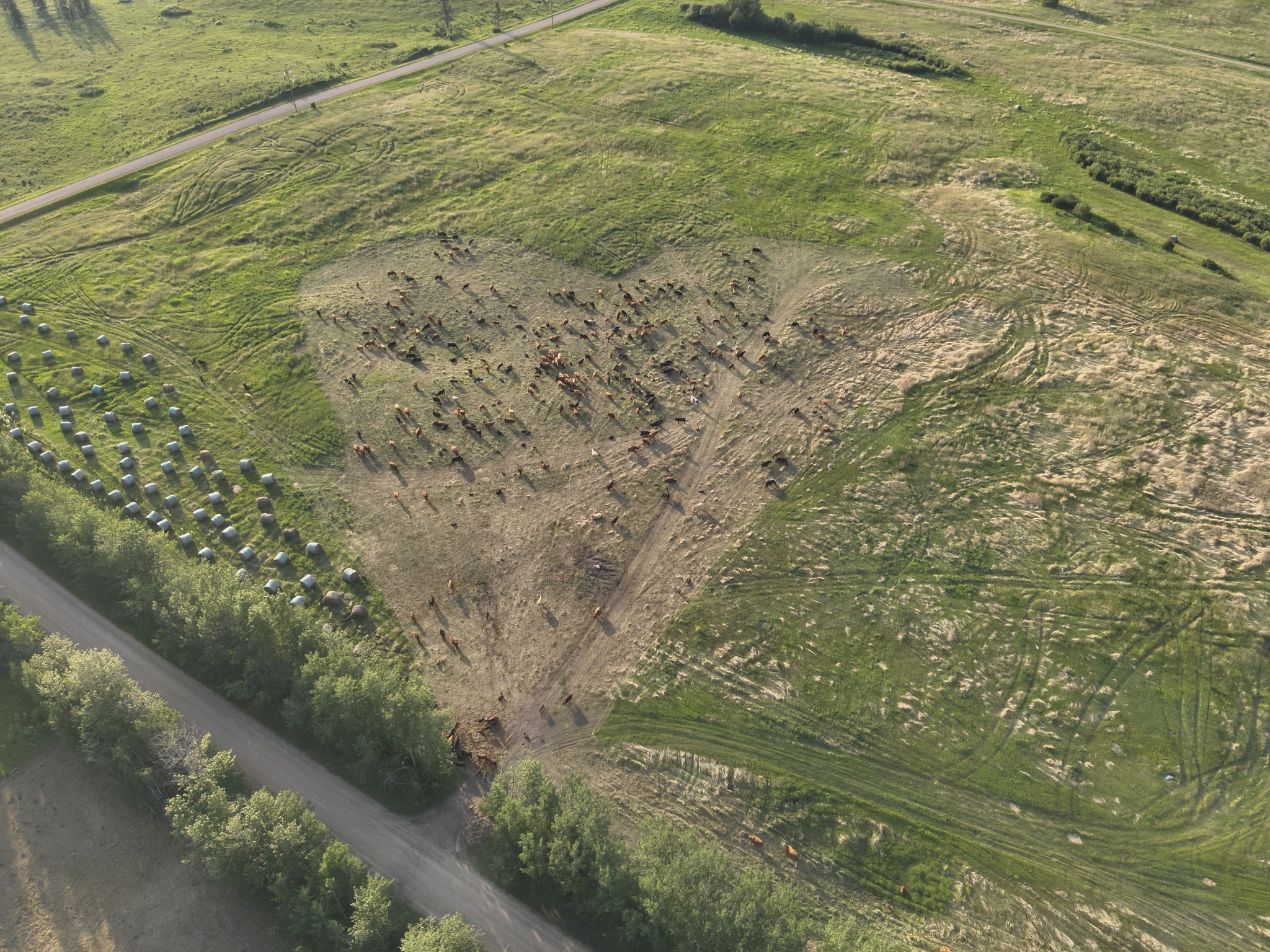
The flexibility of virtual fencing has given Nick more freedom to travel and spend time with family by setting up scheduled moves days in advance and trusting the system to keep cattle on fresh forage. “I recently went to Manitoba and Vancouver and just set up eight or nine moves in advance. It was like I never left.”
Looking Ahead
As winter approaches, Nick is eager to test how eShepherd performs in low-light, snowy conditions, especially its potential to enable cattle to access forage beneath the snow in a controlled, efficient way, and potentially reduce the need for bale feeding. “If we can graze all winter, we’d save a fortune,” he says.
For Nick, eShepherd isn’t just a tool, it’s a catalyst for change. “You can use these animals to impact the land in a way that pushes it forward,” he says. “It’s about working with nature, not against it, and that’s the future I want to be part of.”
Barrington Ranch, located near Crater Mountain in British Columbia, Canada, operates in an environment defined by extreme winter conditions and rugged mountainous terrain. Managing cow/calf pairs across this challenging landscape requires innovation, especially during the harsh winter months. The ranch is managed by Matt Quaedvlieg, who oversees day-to-day operations and grazing strategies. Supporting him is Thomas Alexander, a graduate student at Thompson Rivers University (TRU), who focuses on utilizing and managing the eShepherd technology as part of a research project on the future of rangeland management, under the guidance of Dr. John Church, the cattle research chair at TRU.
Thomas has a long-standing connection to Barrington Ranch, having worked with Matt since he was 13, visiting from Alberta during the summers. Now 23, he plays a key role in integrating eShepherd’s virtual fencing technology into the ranch’s operations. “My responsibilities this year were to manage the collars and ensure the cattle were moving over the landscape correctly under Matt’s direction,” Thomas explains.
Winter grazing has always posed significant challenges at Barrington Ranch, with snow often making it impossible for cattle to graze. “When snow conditions worsen, we need to bring the cattle close to home for feeding,” Thomas says. “Until that point, eShepherd helps us track and contain the herd in nearby pastures.” For Matt, the technology provides a critical advantage in reducing winter feed costs, the ranch’s largest expense. “Extending the grazing period and lowering labor costs with eShepherd significantly reduces our input expenses,” he adds.
Before adopting eShepherd, the ranch relied on conventional fencing and labor-intensive methods for grazing management. Roundups, in particular, were costly and time-consuming, often requiring multiple trips to gather all the animals. Thomas recalls, “This year, with eShepherd collars, we were able to group cattle into a smaller area and use live location tracking to round up every single animal on the first trip—a first since Barrington Ranch began running cattle on this mountain range in 1975.”
The flexibility of eShepherd’s virtual fencing has been a game-changer in navigating the ranch’s rugged terrain. Adjusting boundaries quickly and easily has enabled the team to adapt to changing conditions and manage cattle strategically. “Relocating the base station and adjusting boundaries is simple and efficient,” Thomas notes. Matt emphasizes the system’s ability to mitigate risks, such as keeping cattle away from Ponderosa pine trees that can cause pregnancy issues. “With rotational grazing, we can manage forage more effectively while keeping cattle out of high-risk zones,” he explains.
The time and labor savings provided by eShepherd have been especially impactful. The ranch’s leased winter pasture, located 30 minutes from the home ranch, often required frequent trips for fence maintenance and cattle checks. “With eShepherd, we’ve reduced the need for traditional fencing and the time spent retrieving strays,” says Matt. Thomas adds, “We’ve cut labor costs significantly by eliminating repeated trips for roundup and fence repairs.”
Unexpected benefits have also emerged from using eShepherd. The heatmap feature, which shows cattle concentrations within a pasture, has been instrumental in optimizing grazing decisions. Thomas shares, “We used virtual boundaries to split a large pasture into smaller sections, preventing overgrazing and ensuring consistent utilization across the range, even in historically underused areas.”
Reducing grazing costs and improving productivity have been transformative for Barrington Ranch. “By eliminating traditional fencing expenses and reducing labor needs, we’ve seen meaningful savings,” says Thomas. “The ability to manage cattle movement more effectively has also enhanced forage utilization and pasture health.” Matt agrees, noting that eShepherd’s real-time tracking has streamlined operations and improved herd management.
Looking to the future, both Matt and Thomas are excited about the continued use of eShepherd. Thomas focuses on ensuring the collars maintain battery life during colder temperatures. “We hope the collars maintain battery life effectively through the winter,” he says. Matt envisions broader impacts, saying, “We want to keep reducing costs while improving grazing management and animal health. eShepherd makes that vision achievable.”
With Matt Quaedvlieg’s operational expertise and Thomas Alexander’s technical assistance and research, Barrington Ranch is leveraging eShepherd to transform their winter grazing strategies. This innovative approach not only addresses the challenges of a harsh winter climate but also paves the way for sustainable rangeland management in one of Canada’s most demanding ranching environments.